by Elmer S Soriano
A young female physician friend shared recently how she had not yet started the program for drug-users in her town, despite the fact that rehabilitating 800,000 drug users is an urgent and large scale problem in the Philippines these days. She said she had not yet been trained to address this problem. A hidden perspective is that a young female physician faces personal security risks when she interacts with drug users in a small rural town.
The Bridging Leadership framework (by AIM and Zuellig Family Foundation) propose "ownership" as a core principle in Bridging Leadership. Heifetz and Scharmer both describe the "ownership" mindsets of leaders but from slightly different perspectives.
Heifetz could describe the doctor's mindset as a form of "work avoidance" because the thought of doing the adaptive work on local drug-users could feel too "distressing", or "too hot" for this female physician. She may be conscious or only subconsciously aware of this distress or disequilibrium that she faces. She therefore conveniently declares that she has not yet been trained as a polite way of dis-owning the problem. (See Figure 1).
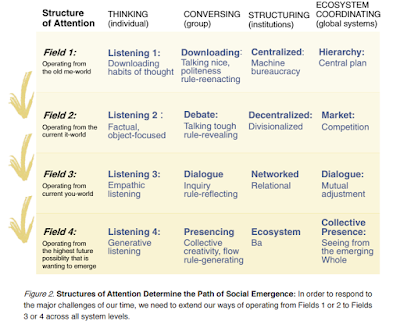
Scharmer would describe the situation as the doctor operating from "me-world" and "it-world", resorting to polite talk or talking tough as opposed to owning the issue at Level 3 and Level 4. (See Table 1 and Figure 2).
Fig.1: Adaptive Learning
Table 1: Phrases as Reflections of Structures of Attention/Ownership
Structure of Attention | Thinking (Individual) | Phrases (Individual) | Phrases (Group) | Phrases (Institutions) |
Level 1 - Operating from the old me-world | Downloading habits of thought | That's not my job description. That could be my job but I don't have the required inputs (training, budget, etc) so I can't do it. | I'm already doing my job and fulfilling my role. | That isn't on our plan for this year. Let's include that in next year's plan and budget. (Or some other organizational excuse.) |
Level 2 - Operating from the current it-world | Factual Object focused | What are the performance gaps? Of the gaps, which are assigned to me? | That's not my job. I've done my part. | Let's refer the client to the assigned service provider (whether or not the providers are adequate.) |
Level 3 - Operating from the current you-world | Empathic Listening | How can I care for the client-partner as myself? | How can we help the client-partner as if we were the client? | How can we change our rules so that we thrive and create shared value with our client-partner? |
Level 4 - Operating from the highest future possibility that is wanting to emerge | Generative Listening | What is emerging? What patterns are being formed? What is called of us? | How can we do things differently? What rules are getting in the way of our preferred future? How can we modify the rules that don't work? | How can we create a space so that we have ongoing adaptation/ transformation? |
Sources:
Leadership on the Line: Staying Alive through the Dangers of Leading (2002) by Martin Linsky , Ronald A. Heifetz


